
ReStretch stretching studio case study: the app and the key metrics
This is a case study of a club in Russia. Some services and payment providers mentioned in the text are not available in Uzbekistan, where Uzcard and Humo cards run through the Atmos gateway.
Fitness centres and sports studios differ in programs and specialisation, yet there are metrics everyone should track. They show how much revenue you earn across the whole relationship with a client and what peak attendance looks like. How does a mobile app help track and improve those numbers?
A few words about the studio
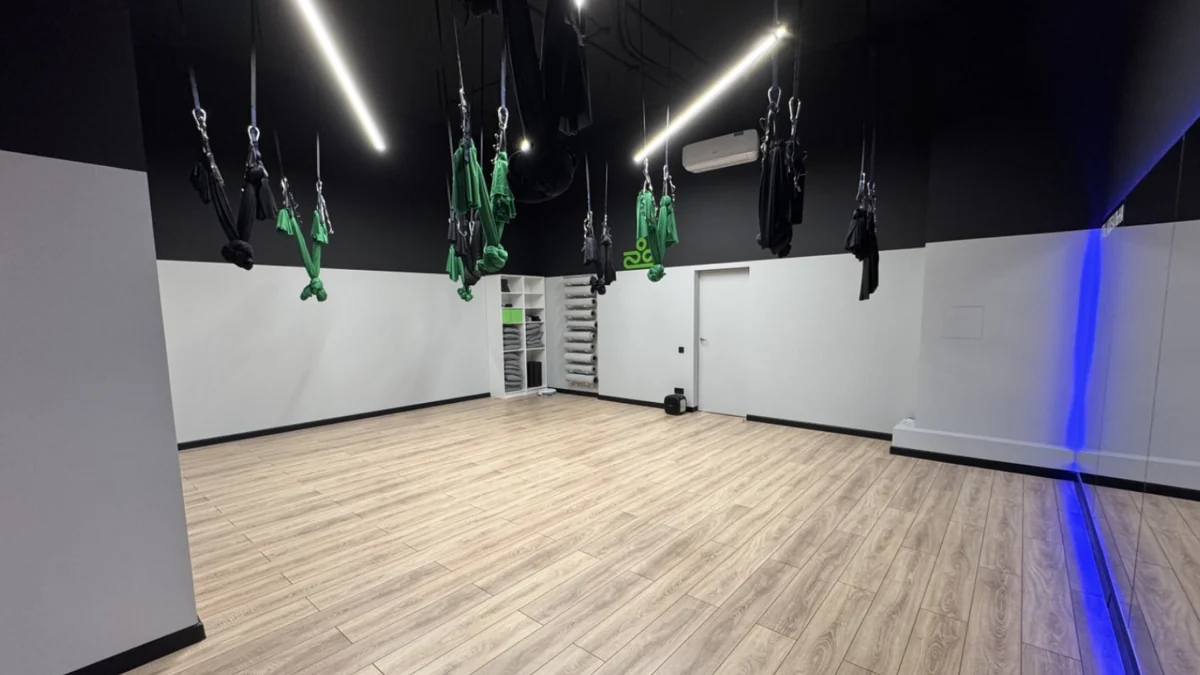
ReStretch is a network of stretching studios with branches in several cities. The average studio covers 110 square meters, with around 200 active clients each. The network opened in 2020.
ReStretch focuses on stretching: classic and aerial stretching, plus pilates. There are other programs too: strength or functional fitness, back health and hatha yoga.
The network has been running for a little over two years, and in that time the founders ran into a series of problems. There was no system that let clients cancel sessions or freeze memberships themselves, or let staff collect feedback and track who was booked where. So ReStretch came to FitBase to adopt a CRM and a mobile app.
What we proposed
We ran a study and found that every fitness club, whatever its specialisation and scale, should watch seven metrics: the renewal rate, the number of clients who have not attended for more than 25 days, the revenue earned across the whole relationship, peak attendance, the number of new members, the cost of acquiring a client, and the conversion from a request into a purchased membership.
At the start of the work with ReStretch we focused on multi-branch support and on rolling out a mobile app branded for the studio and published to the App Store and Google Play.
Before the app was built for every branch, we set up a schedule and online booking widget that worked from a link. That closed the main need: convenient advance booking, because the studio is popular and classes often fill almost instantly.
The widget made booking easier for both clients and staff: previously visitors had to be booked through chats, switching between spreadsheets and reconciling everything by hand.
We automated service tasks to increase renewals
The renewal rate is the share of clients who bought their next membership no later than 30 days after the previous one ended. Can the likelihood of a renewal be assessed? Yes: analyse how often and in what way a client renews, and how regularly they attend.
We also know the renewal rate can be improved through automation, without spending on marketing. It is enough to automate task creation for managers: the system generates the reminder itself when a client needs to be contacted, for instance when a membership, a block of sessions or an instalment payment is coming to an end. That eases the manager's work and the owner's oversight.
We tracked clients who had not attended for over 25 days
This matters: by our statistics, if a client has not been to the club for more than 25 days, the chance of a renewal does not exceed 5 percent. How do you count clients who have been away a long time? Turn on intelligent task assignment for managers, split segments by attendance frequency, then review the statistics by membership type.
We calculated client LTV
Client LTV is the money earned across the whole relationship. It is another important metric we recommend every studio track. Do not simply divide the studio's total revenue by the number of buyers. It is more useful to analyse LTV by different criteria: by the first purchase and by segment.
We analysed peak attendance
Knowing how busy the club is helps avoid both empty and overfilled groups. You do that by relieving the peak periods and filling the idle hours.
How do you gather attendance data? Start recording every client's entry and exit time and run bookings online. Online booking through the schedule widget and the client mobile app is what makes that possible.
You fill in the data about classes, halls and trainers and build the schedule grid. The widget for the website or social media is generated automatically in FitBase. The client sees the classes, free seats and trainers, and can book themselves. The schedule filters by hall, program or staff member.
The system relieves the administrator: they no longer handle bookings. Through the app the client books a class or cancels if plans change. The account also allows freezing a membership and paying for a session online. A reminder about a booked session appears there too: a push notification arrives three hours ahead.
To analyse the group index, ReStretch divides the number of clients who attended a given class by the number of sessions run. Clearly, the fewer people come, the less profitable the class. The network's managers work constantly on raising the group index, expanding the usable floor area so more clients can attend.
We helped improve the onboarding of new clients
A management system lets you monitor the renewal rate, revenue shares and the number of memberships about to expire. Tasks can be created automatically telling managers to remind a client about an expiring membership and motivate a renewal.
An equally important question: how do you settle clients into the studio and build the habit of attending? We recommend free introductory sessions followed by a reminder about the club. Why not ask how the client felt after their first session, and whether they would like to book a second?
We studied the cost of acquiring clients
To calculate this we divided all acquisition spending by the number of people who bought the club's goods or services. The costs included advertising campaigns, marketing and sales salaries and software. We also counted staff bonuses and channels with a delayed purchase, such as outdoor advertising.
The reports the system generates help track all of that spending and judge its effectiveness.
We improved conversion from request to membership
When assessing conversion from a request into a client you should track: the decision time, the mix of clients by acquisition channel, and feedback from every client.
To improve conversion we took several steps. First we simplified booking a class and paying for it in the mobile app. A client can now book a session and pay for a membership in a few taps.
Gathering feedback and keeping in touch with clients was again handled by the system: it is enough to automate the tasks staff will work through.
We also noticed that the 'bring a friend' mechanic works very well in studios. The promotion lets a client and their friend come to a session together and train for free. We optimised the process to make it convenient for both users and the club, minimising manual checking of the promotion's terms. A client can invite friends to sessions through the app: the system recognises the friend at registration and credits the chosen bonuses automatically.
What results we got
In this case study we focused on seven key metrics. We assessed the membership renewal rate, client LTV, peak attendance, client acquisition cost and conversion from a request into a purchased membership. We worked to reduce the number of people who had not attended for over 25 days and to attract more clients.
To improve those numbers we proposed a single solution: a cloud service that optimises the staff's work and simplifies what clients have to do. The system automates tasks, keeps in touch with visitors without forgetting anyone, tracks how busy the studios are and collects feedback.
ReStretch's managers note that once cancelling a session became easy, clients started to un-book rather than simply skip, as they had before. It is convenient that notifications need no manual setup: push handles it. A QR code with a link to download the app was placed at the front desk.
FitBase closed the pain points the ReStretch network had run into: clients can cancel sessions and activate a freeze themselves, and switching between cities became possible.
ReStretch has run on FitBase since March 2021. In the first six months alone, thanks to a joined-up approach to running the studios, automation tools and sound assessment of the key metrics, the ReStretch network grew renewals of active memberships by 15 percent.